 |
| Flag of the United Nations |
Starting in the nineteenth century, global organizations were started to monitor certain global relations, such as telegrams, parcels, and peace. These were all independent groups that were not allied together. After World War I, one of U.S. President Woodrow Wilson’s Fourteen Points was to start a “League of Nations”. The League of Nations was started to "to promote international cooperation and to achieve peace and security" in the Treaty of Versailles. However, the League of Nations was a failure, as its biggest original backer, the United States, failed to join, and therefore, its power and influence was small. The League of Nations ceased after failing to prevent World War II. The League of Nations however influenced the upbringing of a new organization, the United Nations.
 |
| The League of Nations Logo |
The term “United Nations” was first used by President Franklin Roosevelt on January 1, 1942, in the Declaration by United Nations, which was an agreement by 26 nations to continue fighting the Axis powers in World War II. After World War II, in 1945, representatives from 50 member nations met in San Francisco to write the United Nations Charter, which was based on principles created by the United States, Soviet Union, China, and England (the winners of WWII). On October 24, 1945, the UN officially became existent as the charter had been approved by the four nations cited above and a majority of the other 46 countries.
 |
| UN Charter signing-1945 |
At this time (and just as much so today), the United Nations had a lot of action to take. One of the first actions the United Nations took was to approve the Conventions on Genocide, which was especially prevalent at the time after the Holocaust, the massive genocide conducted by Nazi Germany to exterminate Jews and other “undesirable” ethnic/religious groups. The Conventions on Genocide (see below post with it for precise wording and a full definition of “genocide”) outlawed genocide, attempting genocide, and conspiring to commit genocide. As well, all member nations of the United Nations were obliged to intervene if they were knowingly aware of genocide happening in the world. This law is still in effect (at least technically). Since then, more nations have joined the United Nations (today, almost all nations are UN members). Since then, genocides have occurred throughout the world.
As an agency, the United Nations has no standing army, and relies on member nations to fund it both monetarily when money is needed and with troops when intervention is needed. When the UN sends in troops to intervene in a situation, the troops cannot fire/attack unless if they were first attacked. However, these troops are still often effective peacekeepers where they are serving. The United Nations is controlled by its member nations in two major parts, as well as numerous other organizations that monitor almost every aspect of human existence. The two most important parts of the U.N. are the General Assembly and the Security Council. Every member nation has an equal vote in the General Assembly, and its decisions are controlled by simple or 2/3 majority depending on the type of issue.
 |
| UN General Assembly |
The Security Council has 5 permanent members (United States, England, France, Russia, and China) and 10 non-permanent members that alternate. The Security Council discusses threats to peace, and tries to mediate them at first. All decisions made by this group are unanimous, so if one member disagrees, no action will take place.
The Security Council has had many geopolitical divides since its founding, so its influence is limited. It could not intervene during the Cold War, since the United States and Soviet Union were both members. As a result, many nations will simply avoid it and use the power they believe they have. As per Michael J. Glennon, a foreign policy expert who occasionally writes for Foreign Affairs, the Security Council is broken, shown especially after the Bush administration did not work with it significantly before invading Iraq. One Bush administration member said “we don’t need the Security Council.” However, it assumed a crucial role in enforcing the Genocide conventions. Article VIII in the Convention on Genocide states "any contracting party may call upon the competent organs of the UN to take such action under the Charter of the UN as they consider appropriate for the prevention and suppression of acts of genocide…”. However, the Security Council has failed at enforcing policies in the Genocide convention.
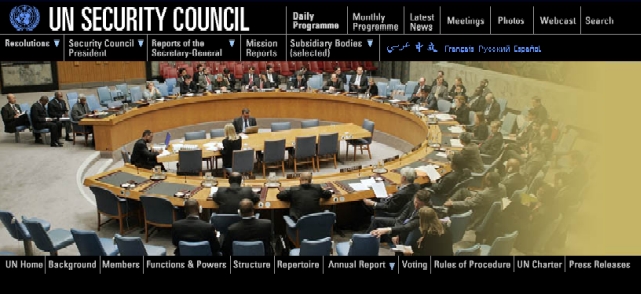 |
| The UN Security Council (a picture of their website homepage, but also the chamber) |
Although all member nations are obliged to intervene in cases of genocide, being led by the UN, that has not happened. Since the creation of the UN, genocides have clearly occurred in Rwanda, Bosnia, Kosovo, and Darfur (Sudan), and other mass crimes against humanity (that could perhaps be considered genocide) have occurred in China, Cambodia, East Timor, and the Democratic Republic of Congo. As well, current legislation under consideration in Uganda would authorize murder of all those involved in sexual activity with the same sex, which would currently fall under conspiracy to commit genocide under the convention. However, the UN and its member nations as a whole have not taken major intervention in any of these situations. Often, such as in the situation in 1994 in Rwanda, member nations will avoid referring to a crisis on genocide, so they do not need to intervene. The first time the United States ever referred to a situation as genocide was the Darfur crisis in September 2004, when Sec. of State Colin Powell testified before Congress that "We concluded -- I concluded -- that genocide has been committed in Darfur and that the Government of Sudan and the Janjaweed bear responsibility -- and that genocide may still be occurring." In order for a policy to be effective, it must be enforced, and therefore followed. However, a major flaw in many UN policies, such as the 1948 Convention on Genocide, is that it is not enforced, and there are no consequences when it is not followed. For example, the genocide in Darfur has been going on for about 8 years, and yet there has been nothing significant done to stop it, although it is recognized as a genocide. During the 1994 genocide in Rwanda, as it began, almost every nation withdrew their UN peacekeeping troops from Rwanda as the genocide began, and once leadership recognized it was a genocide (which is a whole other topic), it was too late, and they still refused to send peacekeeping troops, although the UN approved additional peacekeepers once it was recognized as genocide.
 |
| UN Peacekeepers in Darfur. They exist, but they are too few in numbers |
The United Nations was set up in 1945 to achieve admirable goals, and to make the world a better place. Although its impact on the world is definitely positive, and its work is admirable, it relies totally on the cooperation of member countries. If the member countries do not cooperate, the UN is powerless. The UN is often a stalemate on the most urgent and crucial issues, due to its governance set-up, while it can make small steps on less urgent issues. It is difficult to punish a nation, especially a Security Council member, for its actions due to the set-up. When agreements are broken, nothing is done except hindsight by member nations. The United Nations will continue improving the world, but cannot solve all the world’s problems, especially some of the most problematic, due to existing geopolitical issues.
The video above explains everything the United Nations does to improve the world, and they do that. However, failures of the UN seem to be highlighted and successes seem to be underplayed in the news. The United Nations works hard every day to make the world a better place.

This is a very informative blog, and it helped me learn a lot more about the United Nations in general. I really liked the way you incorporated pictures to give me a much clearer understanding of what I was reading. I also liked how you were able to incorporate two different genocides into your writing. I wish more people would be willing to send in peacekeepers to keep these genocides from ocurring over and over again. It's hard to imagine that the world still hasn't done much at Darfur. In the end... very nice blog George.
ReplyDeleteI would think that the United Nations should gain a more authoritative stance and sanction nations that do not intervene in genocide, but since no nation is willing to stand up, nothing will be done. It's a tragedy that not one powerful nation is willing to stand up. While its admirable that nations like Ghana have intervened, their military can not do all of it.
ReplyDeleteGreat blog, George. Information just exploded on me as I read this post. It helped me learn more about the United Nations in general. I really liked how you incorperated two different Genocides (Rwanda & Darfur) and kept on giving steady information about them. I think that the UN should take a stronger approach on Genocide, not just tolerate it. You mention multiple Genocides that occured that the UN just ignored. I was informed of many things here, George. Great Blog!
ReplyDeleteThis is a really informative post on the United Nations. It clearly shows how the United Nations was formed and what it's purpose is in the world. It's a shame however, that the U.N. has failed to intervene with past genocides. During the Rwanda genocide the U.N. should have deployed more peacekeepers instead of military observers, in my opinion. Let's hope in the future the U.N. will put in more effort on peacekeeping. This is a really informative blog. Good work George.
ReplyDeleteyour post is very informative and encompassing. the pictures are well places and there is so many facts and interesting sentances. nice job -megan
ReplyDelete